
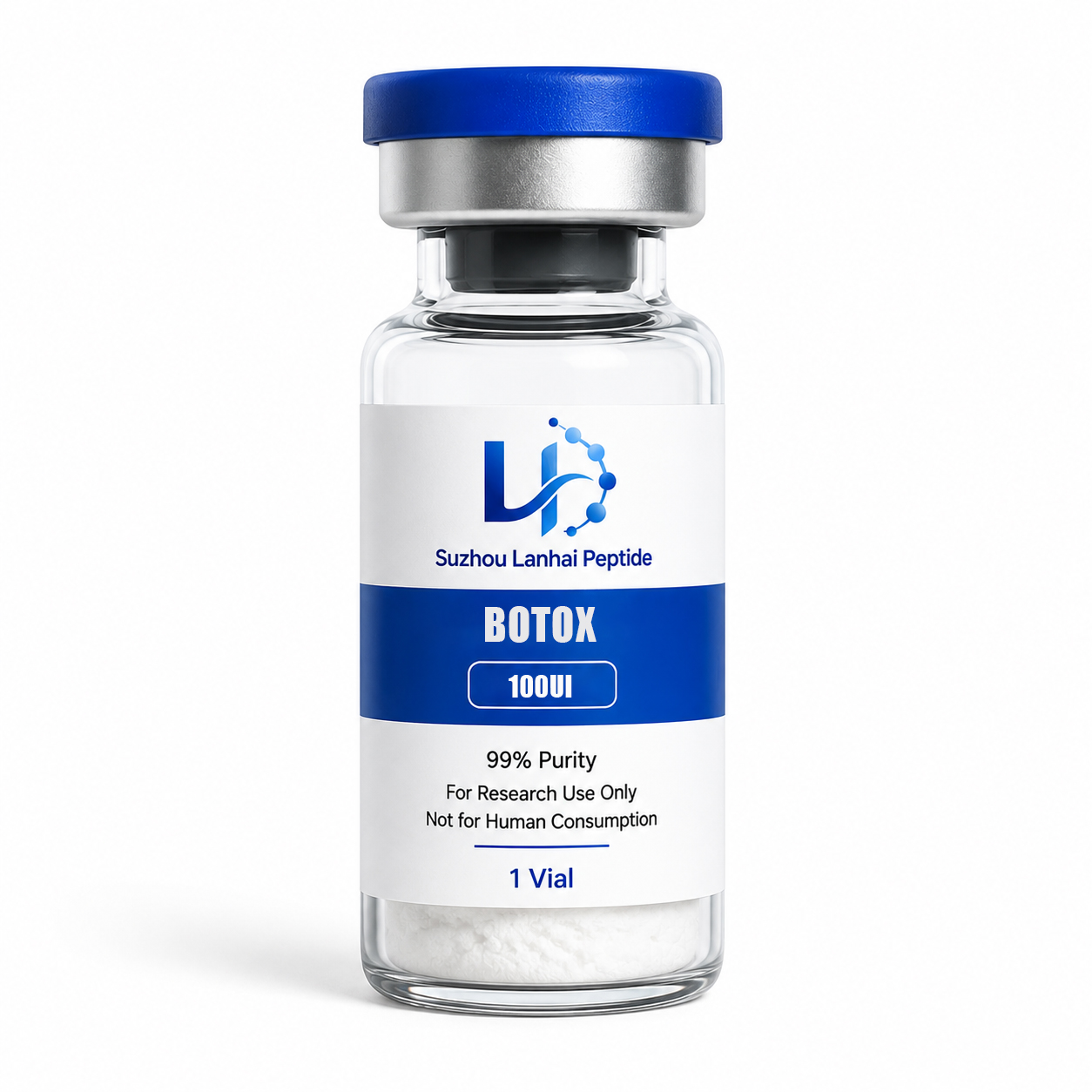
Botolinum Toxin 100ui
$28.00
1 Vial/ Kit
Comprehensive Guide to Botulinum Toxin Type A (100 IU): Neurotoxin Structure, Neuromuscular Research Standards, and Analytical Purity
Welcome to Suzhou Lanhai Peptide, your trusted global source for advanced synthetic research compounds, specialized biological proteins, and laboratory storage solutions. In modern neurobiology research, neuromuscular junction physiology studies, and advanced pharmacological formulation research, investigating targeted clostridial neurotoxins requires absolute precision, verifiable purity, and strict compliance with research standards. When exploring SNARE protein cleavage mechanisms, cholinergic transmission blockade, and synaptic vesicle dynamics, utilizing high-purity Botulinum Toxin Type A (100 IU) is vital for achieving reproducible scientific outcomes.
This comprehensive guide explores the structural architecture, biochemical properties, analytical verification standards, and proper laboratory storage protocols for Botulinum Toxin Type A 100 IU. By examining real-world industry benchmarks and analytical standards, we outline why optimized sourcing and handling are fundamental to advanced neurological and biophysical research.
1. Understanding Botulinum Toxin Type A: Structure, Mechanism, and Research Scope
Botulinum Toxin Type A is a high-molecular-weight ($\sim 150 \text{ kDa}$) protein complex produced by the bacterium Clostridium botulinum. Structurally, it consists of a heavy chain ($\sim 100 \text{ kDa}$) responsible for targeted cellular binding and internalization, and a light chain ($\sim 50 \text{ kDa}$) possessing zinc-dependent endopeptidase activity.
The Mechanism of Action in Biomedical Research
In contemporary biochemical and pharmacological investigations, Botulinum Toxin Type A is examined for several key cellular pathways:
-
SNAP-25 Cleavage and SNARE Complex Inhibition: The light chain acts as a specific zinc endopeptidase that cleaves SNAP-25 (Synaptosomal-associated protein 25), a critical component of the SNARE protein complex required for acetylcholine-containing vesicle fusion at the presynaptic membrane.
-
Blockade of Neuromuscular Transmission: Research demonstrates that this cleavage successfully inhibits neurotransmitter exocytosis at the neuromuscular junction, inducing flaccid muscle paralysis models in controlled in vitro and ex vivo settings.
-
Autonomic and Sensory Pathway Studies: Laboratory investigations evaluate its role in modulating autonomic neurotransmission, inhibiting peripheral nociceptive peptide release (such as CGRP and Substance P), and studying neuroplasticity in chronic pain models.
2. Analytical Verification and High-Purity Synthesis Standards
For institutional buyers, academic researchers, and biotechnology procurement managers, batch verification is paramount. Biological neurotoxin complexes require rigorous chromatography, gel electrophoresis, and biological potency assays (such as the LD50 or cell-based assay equivalents) to ensure exact toxicological profiling and structural integrity.
High-Performance Liquid Chromatography (HPLC) and Potency Verification
Every batch of Botulinum Toxin Type A 100 IU distributed by Suzhou Lanhai Peptide undergoes rigorous analytical verification to guarantee purity levels exceeding 98%, ensuring minimal denatured protein content or inactive protein fractions.
Technical Specification Comparison
| Specification Parameter | Standard Research Grade | Premium Analytical Grade |
| Toxin Classification | Clostridium Botulinum Type A Complex | Clostridium Botulinum Type A Complex |
| Biological Potency | 100 International Units (IU) / Vial | 100 International Units (IU) / Vial |
| Purity Profile | $\ge 98.0\%$ (Chromatographically Pure) | $\ge 99.0\%$ (High-Resolution Purified) |
| Formulation | Lyophilized Vacuum-Sealed Powder | Lyophilized Vacuum-Sealed Powder |
| Storage Conditions | $-20^\circ C$ or below, desiccated | $-20^\circ C$ or below, desiccated |
3. Laboratory Handling, Reconstitution, and Storage Protocols
Botulinum Toxin Type A is supplied as a stabilized, vacuum-freeze-dried (lyophilized) powder containing accessory proteins to maintain structural stability. Proper biosafety handling and sterile technique are essential.
Reconstitution Best Practices
-
Solvent Selection: Reconstitute lyophilized Botulinum Toxin 100 IU using sterile, preservative-free $0.9\%$ sodium chloride injection solution in a certified biosafety cabinet or laminar flow hood.
-
Gentle Mixing: Introduce the diluent slowly into the vial and gently swirl. Avoid vigorous shaking or turbulent bubbling, as high shear forces can denature the delicate protein structure and diminish biological potency.
Cold-Chain and Storage Guidelines
-
Dry Powder Storage: Store sealed vials of lyophilized neurotoxin in a dedicated freezer at $-20^\circ C$ or lower, protected from light and moisture.
-
Reconstituted Storage: Once reconstituted, solutions should be maintained between $2^\circ C$ and $8^\circ C$ and utilized immediately within short-term experimental windows to prevent protein degradation.
4. Mandatory Research Disclaimer and Compliance
-
For Laboratory and Research Use Only: All neurotoxin and biological products offered by Suzhou Lanhai Peptide, including Botulinum Toxin Type A 100 IU, are strictly intended for in vitro laboratory research, analytical testing, and scientific study by trained personnel. They are not approved for human consumption, clinical trials on humans, aesthetic procedures, cosmetic self-administration, veterinary use, or therapeutic injection.
5. Frequently Asked Questions (FAQs)
1. What is the primary biological target of Botulinum Toxin Type A?
Botulinum Toxin Type A targets and cleaves SNAP-25, a core protein in the SNARE complex, thereby preventing acetylcholine release at the neuromuscular junction.
2. How many International Units (IU) are contained in each vial?
Each vial contains 100 International Units (IU) of stabilized, purified Botulinum Toxin Type A complex formulated as a lyophilized powder.
3. How should lyophilized Botulinum Toxin 100 IU be stored prior to reconstitution?
Unconstituted vials should be stored securely in a freezer at $-20^\circ C$ or lower, kept dry and protected from light.
4. Are Certificates of Analysis (COAs) provided with orders?
Yes. Every order includes or provides access to batch-specific analytical documentation, purity metrics, and potency verification reports for institutional compliance.
5. Can this product be used for cosmetic wrinkle removal or clinical treatments?
No. All products sold by Suzhou Lanhai Peptide are restricted strictly to laboratory research and development use only and are prohibited from human, clinical, or cosmetic application.
Be the first to review “Botolinum Toxin 100ui”
Related products

Pure Peptides
Pure Peptides

Pure Peptides

Pure Peptides

Pure Peptides

Pure Peptides

Pure Peptides

Pure Peptides
Reviews
There are no reviews yet.