
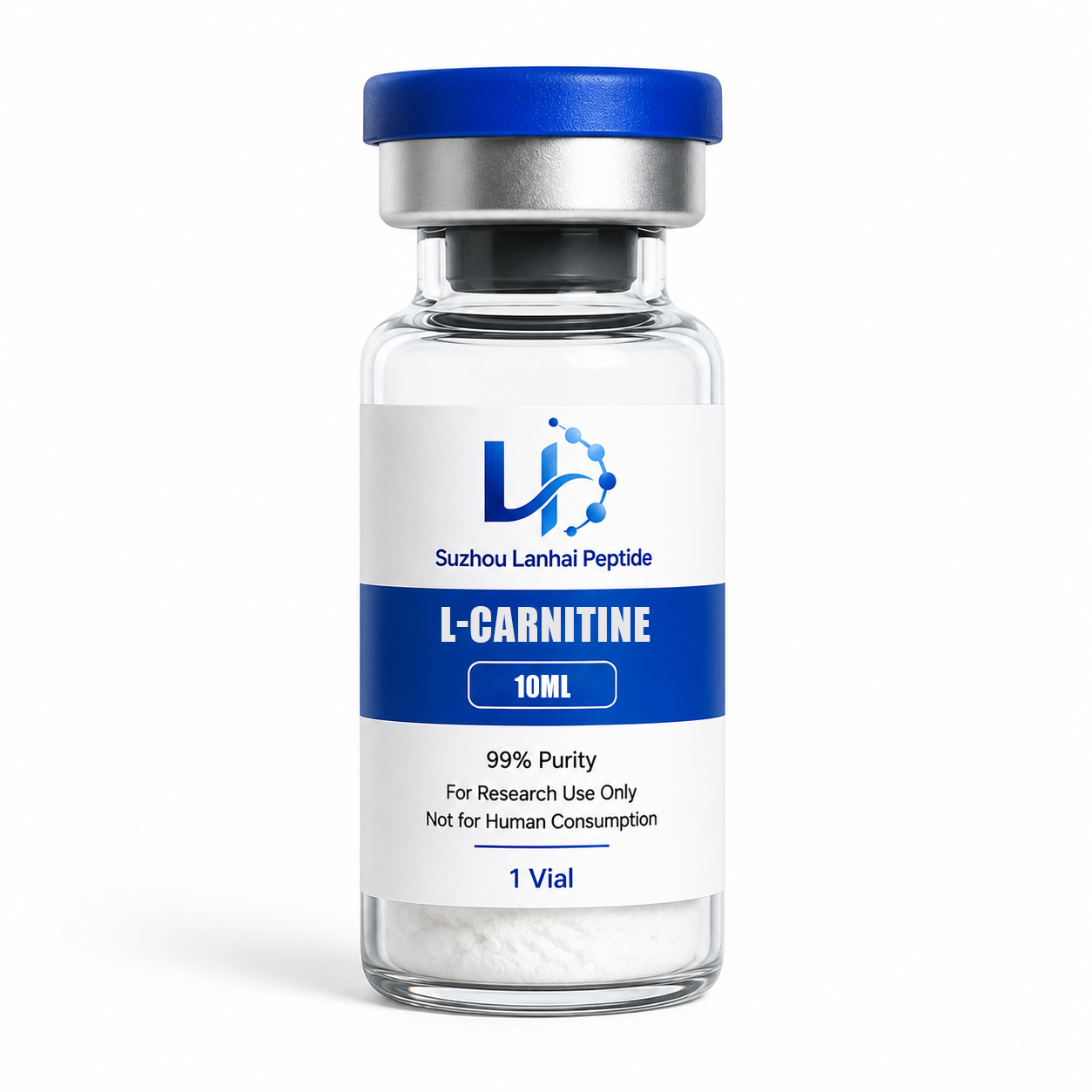
L-Carnitine 10ml
$38.00
10 Vials/ Kits
Comprehensive Guide to L-Carnitine 10ml: Quaternary Ammonium Compound Structure, Mitochondrial Oxidation Research Standards, and Analytical Purity
Welcome to Suzhou Lanhai Peptide, your trusted global source for advanced synthetic peptides, amino acid derivatives, and specialized laboratory storage solutions. In modern cellular metabolism research, mitochondrial bioenergetics studies, and advanced pharmaceutical formulation research, investigating targeted metabolic transporters requires absolute precision, verifiable purity, and strict compliance with research standards. When exploring fatty acid beta-oxidation, acylcarnitine shuttle kinetics, and cellular energy metabolism, utilizing high-purity L-Carnitine 10ml liquid research solutions is vital for achieving reproducible scientific outcomes.
This comprehensive guide explores the molecular structure, biochemical properties, analytical verification standards, and proper laboratory storage protocols for L-Carnitine 10ml. By examining real-world industry benchmarks and analytical chemistry standards, we outline why optimized sourcing and handling are fundamental to advanced metabolic and biochemical research.
1. Understanding L-Carnitine: Structure, Mechanism, and Research Scope
L-Carnitine ($\beta$-hydroxy-$\gamma$-trimethylaminobutyrate) is a naturally occurring amino acid derivative that plays a critical role in energy production by transporting long-chain fatty acids into the mitochondria for beta-oxidation.
The Mechanism of Action in Biomedical Research
In contemporary biochemical and pharmacological investigations, L-Carnitine is examined for several key cellular pathways:
-
The Carnitine Acyltransferase Shuttle System: L-Carnitine acts as an essential co-factor enabling the transfer of activated fatty acids (acyl-CoA esters) across the inner mitochondrial membrane via carnitine palmitoyltransferase I and II (CPT-I and CPT-II).
-
Mitochondrial Energy Homeostasis: Research demonstrates that adequate intracellular carnitine pools prevent the accumulation of toxic acyl groups, buffering the acyl-CoA/CoA ratio and maintaining optimal Krebs cycle flux during periods of high metabolic demand.
-
Oxidative Stress and Cellular Protection: In vitro and animal model research evaluates its capacity to reduce reactive oxygen species (ROS), support endothelial function, and protect cellular membranes from lipid peroxidation.
2. Analytical Verification and High-Purity Standardization Standards
For institutional buyers, academic researchers, and biotechnology procurement managers, batch verification is paramount. Liquid biochemical formulations require rigorous high-performance liquid chromatography (HPLC) and optical rotation assays to ensure exact enantiomeric purity (L-isomer confirmation) and concentration integrity.
High-Performance Liquid Chromatography (HPLC) and Concentration Verification
Every batch of L-Carnitine 10ml distributed by Suzhou Lanhai Peptide undergoes rigorous analytical verification to guarantee purity levels exceeding 98% to 99%+, ensuring minimal degradation products, inactive D-isomer contaminants, or impurities.
Technical Specification Comparison
| Specification Parameter | Standard Research Grade | Premium Analytical Grade |
| Compound Identity | L-Carnitine Base / Solution | L-Carnitine Base / Solution |
| Enantiomeric Purity | $\ge 99.0\%$ L-Isomer | $\ge 99.9\%$ L-Isomer |
| Purity / Potency (HPLC) | $\ge 98.0\%$ | $\ge 99.2\%$ |
| Formulation | 10ml Liquid Solution / Vial | 10ml Liquid Solution / Vial |
| Analytical Testing | Verified HPLC & Assay Profile | Verified HPLC & Assay Profile |
| Storage Conditions | $2^\circ C$ to $8^\circ C$, dark, sealed | $2^\circ C$ to $8^\circ C$, dark, sealed |
3. Laboratory Handling, Preparation, and Storage Protocols
Liquid carnitine formulations require careful handling to preserve chemical stability and prevent microbial contamination in multi-use or open research environments.
Preparation Best Practices
-
Aseptic Technique: Handle liquid aliquots in a clean laminar flow hood using sterile micropipettes and containers to maintain sample integrity.
-
Dilution and Buffering: If working with analytical buffers, dilute using sterile water for injection or isotonic saline matching experimental parameters.
Cold-Chain Storage Guidelines
-
Vial Storage: Store sealed liquid vials in a refrigerated environment between $2^\circ C$ and $8^\circ C$ protected from direct light and moisture.
-
Shelf-Life Management: Once unsealed, maintain aseptic storage conditions and utilize within recommended short-term experimental windows.
4. Mandatory Research Disclaimer and Compliance
-
For Laboratory and Research Use Only: All metabolic and biochemical products offered by Suzhou Lanhai Peptide, including L-Carnitine 10ml, are strictly intended for in vitro laboratory research, analytical testing, and scientific study. They are not approved for human consumption, clinical trials on humans, injection, veterinary use, or therapeutic self-administration.
5. Frequently Asked Questions (FAQs)
1. What is the primary biochemical role of L-Carnitine?
L-Carnitine serves as an essential transporter molecule that moves long-chain fatty acids into the mitochondria so they can be oxidized for cellular energy production.
2. What purity level does Suzhou Lanhai Peptide guarantee for L-Carnitine 10ml?
Every batch of L-Carnitine 10ml is backed by analytical documentation confirming an HPLC purity and potency rating of 98% to 99% or higher, with verified L-isomer dominance.
3. How should L-Carnitine 10ml liquid solution be stored prior to use?
Vials should be stored tightly sealed in a refrigerated environment between $2^\circ C$ and $8^\circ C$ protected from light to maintain chemical stability.
4. Are Certificates of Analysis (COAs) provided with orders?
Yes. Every order includes or provides access to batch-specific HPLC and analytical testing reports to verify compound integrity for institutional compliance.
5. Can L-Carnitine 10ml be used for human injection or weight loss treatments?
No. All products sold by Suzhou Lanhai Peptide are restricted strictly to laboratory research and development use only and are prohibited from human or clinical application.
Be the first to review “L-Carnitine 10ml”
Related products
Pure Peptides

Pure Peptides

Pure Peptides

Pure Peptides

Pure Peptides

Pure Peptides

Pure Peptides

Pure Peptides
Reviews
There are no reviews yet.