
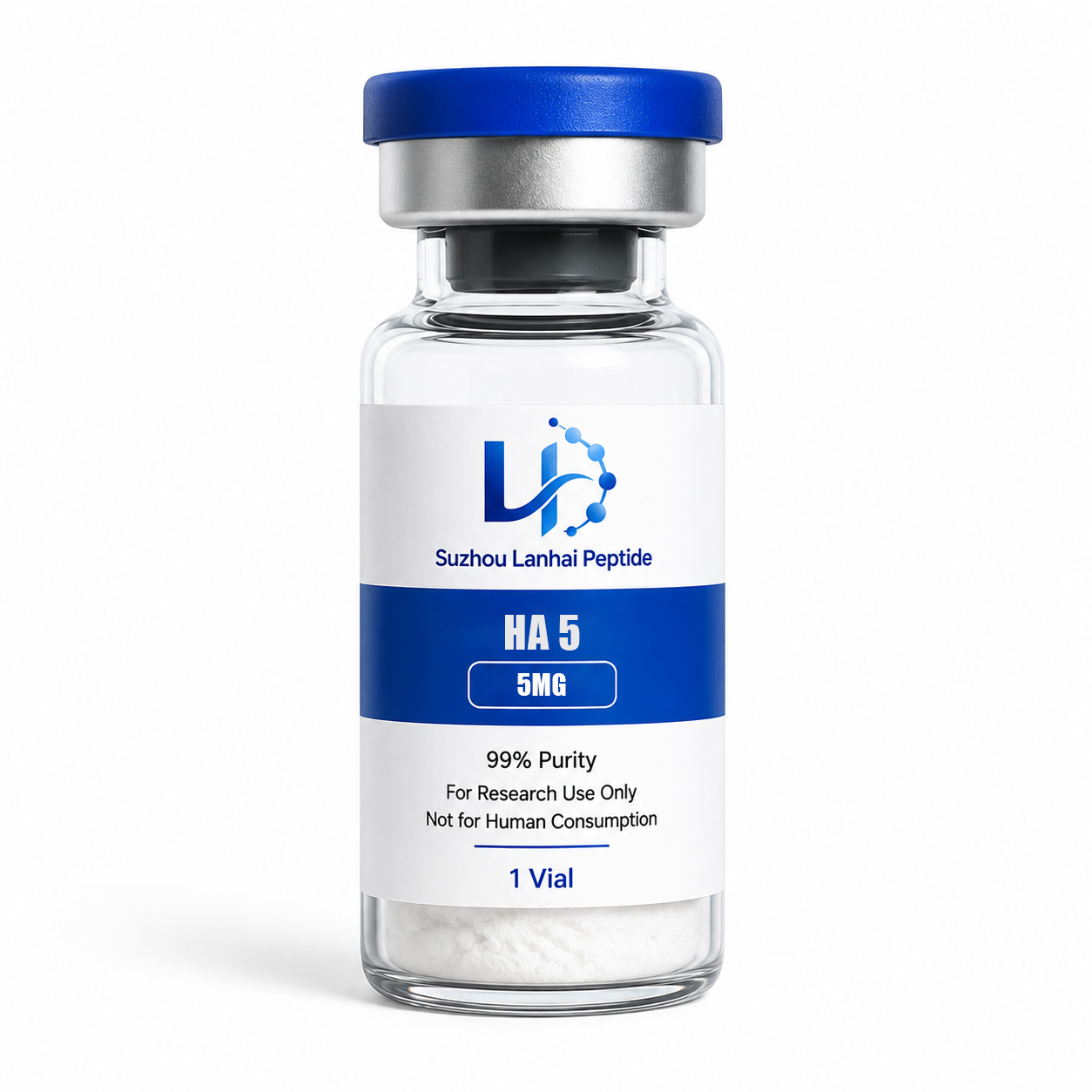
Hyaluronic acid 5mg
$135.00
1 Vial
Comprehensive Guide to Hyaluronic Acid 5mg: Glycosaminoglycan Structure, Extracellular Matrix Research Standards, and Analytical Purity
Welcome to Suzhou Lanhai Peptide, your trusted global source for advanced synthetic peptides, amino acid derivatives, specialized laboratory storage solutions, and high-purity biological macromolecules. In modern regenerative medicine, extracellular matrix (ECM) remodeling studies, and advanced pharmaceutical formulation research, investigating structural glycosaminoglycans requires absolute precision, verifiable purity, and strict compliance with research standards. When exploring tissue hydration, chondrocyte proliferation pathways, and dermal matrix mechanics, utilizing high-purity Hyaluronic Acid 5mg is vital for achieving reproducible scientific outcomes.
This comprehensive guide explores the structural disaccharide composition, biochemical properties, analytical verification standards, and proper laboratory storage protocols for Hyaluronic Acid 5mg. By examining real-world industry benchmarks and analytical chemistry standards, we outline why optimized sourcing and handling are fundamental to advanced biochemical research.
1. Understanding Hyaluronic Acid: Structure, Mechanism, and Research Scope
Hyaluronic Acid (HA, Hyaluronan) is a non-sulfated high-molecular-weight glycosaminoglycan distributed widely throughout connective, epithelial, and neural tissues. It is composed of repeating polymeric disaccharide units of D-glucuronic acid and N-acetyl-D-glucosamine linked via alternating $\beta$-(1$\rightarrow$4) and $\beta$-(1$\rightarrow$3) glycosidic bonds.
The Mechanism of Action in Biomedical Research
In contemporary biochemical and pharmacological investigations, Hyaluronic Acid is examined for several key cellular pathways:
-
CD44 and Receptor-Mediated Signaling: HA binds selectively to cell-surface receptors such as CD44 and RHAMM (Receptor for Hyaluronan-Mediated Motility), triggering intracellular signaling cascades that regulate cell adhesion, migration, and proliferation.
-
Extracellular Matrix and Hydration Dynamics: Due to its unique physicochemical property of binding and retaining significant volumes of water molecules, HA is utilized in in vitro matrix models to simulate viscoelastic tissue environments and study osmotic shock protection.
-
Regenerative and Wound Healing Studies: In vitro and animal model research evaluates its role in scaffolding cellular migration, supporting fibroblast proliferation, and modulating inflammatory cytokine expression during tissue repair.
2. Analytical Verification and High-Purity Synthesis Standards
For institutional buyers, academic researchers, and biotechnology procurement managers, batch verification is paramount. Biological polymers require rigorous molecular weight distribution profiling and endotoxin testing to ensure consistency across experimental setups.
Size-Exclusion Chromatography (SEC-HPLC) and Viscosimetry
Every batch of Hyaluronic Acid 5mg distributed by Suzhou Lanhai Peptide undergoes rigorous verification via SEC-HPLC to guarantee high purity levels exceeding 98% to 99%+, ensuring minimal protein or nucleic acid contaminants.
Spectroscopic and Structural Validation
Fourier-transform infrared spectroscopy (FTIR) and nuclear magnetic resonance (NMR) confirm the exact repeating disaccharide backbone structure, ensuring batch-to-batch structural uniformity.
Technical Specification Comparison
| Specification Parameter | Standard Research Grade | Premium Analytical Grade |
| Polymer Identity | Sodium Hyaluronate (Glycosaminoglycan) | Sodium Hyaluronate (Glycosaminoglycan) |
| Purity / Assay | $\ge 98.0\%$ | $\ge 99.2\%$ |
| Molecular Weight Profile | Defined Research Range | Defined Research Range |
| Formulation | 5mg Lyophilized Powder / Fine Granules | 5mg Lyophilized Powder / Fine Granules |
| Storage Conditions | $2^\circ C$ to $8^\circ C$ desiccated | $2^\circ C$ to $8^\circ C$ desiccated |
3. Laboratory Handling, Reconstitution, and Storage Protocols
Hyaluronic acid polymers are supplied as stabilized, highly refined powders or lyophilized cakes. Proper laboratory handling is essential to preserve polymer chain length and prevent shear degradation during dissolution.
Reconstitution Best Practices
-
Solvent Selection: Reconstitute lyophilized Hyaluronic Acid 5mg using sterile, endotoxin-free water for injection or analytical phosphate-buffered saline (PBS) in a clean laminar flow hood.
-
Dissolution Dynamics: Allow the powder to hydrate slowly without aggressive mechanical stirring to prevent mechanical chain scission (shearing of high-molecular-weight polymer chains).
Cold-Chain Storage Guidelines
-
Dry Powder Storage: Store sealed vials of hyaluronic acid in a cool, dry environment between $2^\circ C$ and $8^\circ C$ away from light and moisture.
-
Reconstituted Storage: Once reconstituted into aqueous buffers, solutions should be kept under refrigeration ($2^\circ C$ to $8^\circ C$) with appropriate antimicrobial agents if stored for extended periods, or utilized promptly in experimental assays.
4. Mandatory Research Disclaimer and Compliance
-
For Laboratory and Research Use Only: All biochemical and polymer products offered by Suzhou Lanhai Peptide, including Hyaluronic Acid 5mg, are strictly intended for in vitro laboratory research, analytical testing, and scientific study. They are not approved for human consumption, clinical trials on humans, veterinary use, or therapeutic self-administration.
5. Frequently Asked Questions (FAQs)
1. What is the chemical structure of the Hyaluronic Acid supplied?
Hyaluronic Acid is a high-molecular-weight linear glycosaminoglycan consisting of repeating disaccharide units of D-glucuronic acid and N-acetyl-D-glucosamine.
2. What purity level does Suzhou Lanhai Peptide guarantee for Hyaluronic Acid 5mg?
Every batch of Hyaluronic Acid 5mg is backed by analytical documentation confirming an assay purity rating of 98% to 99% or higher.
3. How should dry Hyaluronic Acid 5mg be stored prior to reconstitution?
Vials of dry powder should be stored tightly sealed in a dry environment between $2^\circ C$ and $8^\circ C$ to maintain structural stability.
4. Are Certificates of Analysis (COAs) provided with orders?
Yes. Every order includes or provides access to batch-specific analytical testing and molecular weight profile reports for institutional compliance.
5. Can this Hyaluronic Acid be used in human clinical or cosmetic applications?
No. All products sold by Suzhou Lanhai Peptide are restricted strictly to laboratory research and development use only and are prohibited from human or clinical application.
Be the first to review “Hyaluronic acid 5mg”
Related products

Pure Peptides

Pure Peptides

Pure Peptides

Pure Peptides

Pure Peptides

Pure Peptides

Pure Peptides
Pure Peptides
Reviews
There are no reviews yet.