
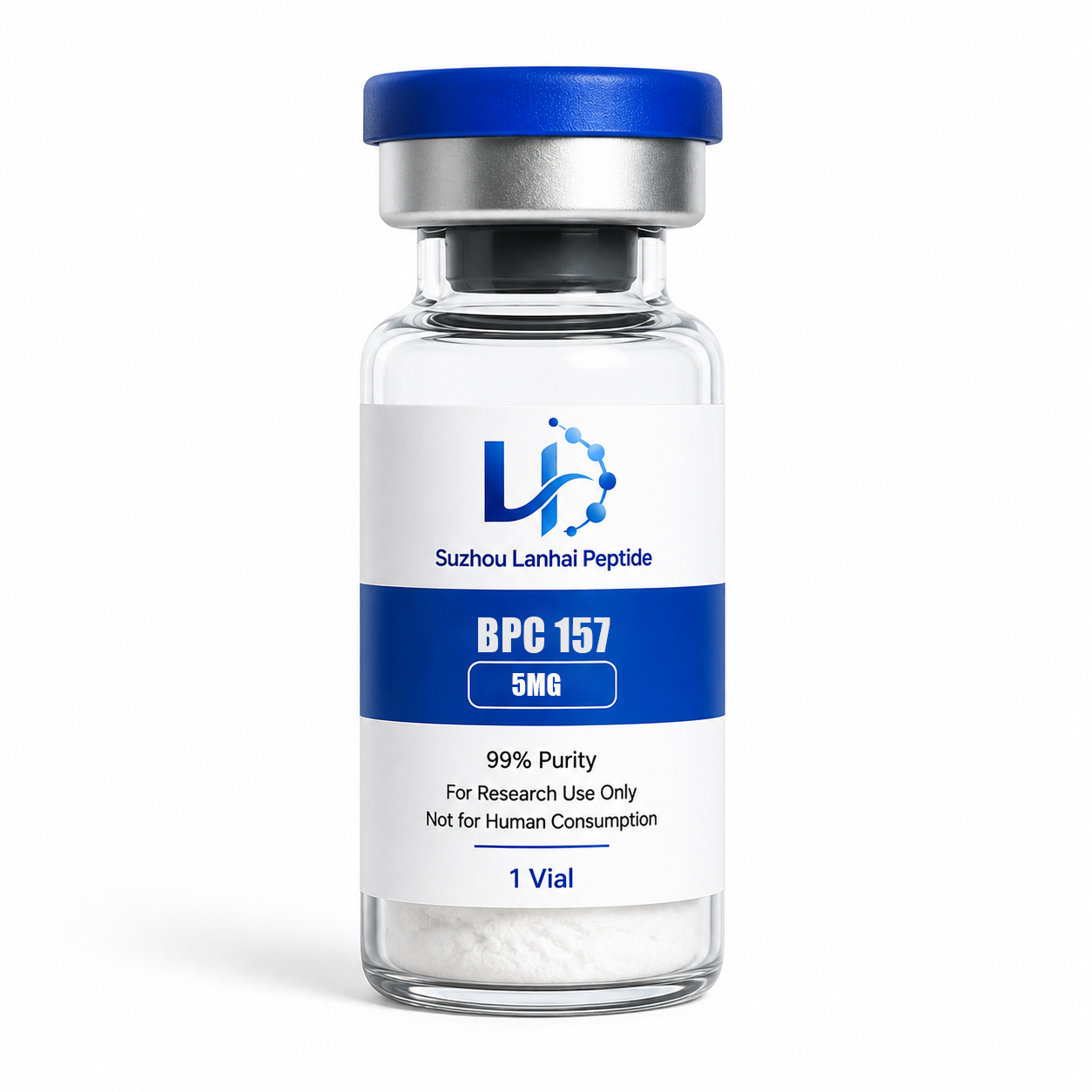
Buy BPC 157 5mg Peptide
$44.00
Comprehensive Guide to BPC-157 5mg: Synthetic Pentadecapeptide Structure, Regenerative Research Standards, and Analytical Purity
Welcome to Suzhou Lanhai Peptide, your trusted global source for advanced synthetic peptides, amino acid derivatives, and specialized laboratory storage solutions. In modern pharmaceutical synthesis, tissue regeneration studies, and advanced biochemical research, investigating specialized oligopeptides requires absolute precision, verifiable purity, and strict compliance with research standards. When exploring angiogenesis pathways, cytoprotective mechanisms, and cellular repair processes, utilizing high-purity BPC-157 5mg is vital for achieving reproducible scientific outcomes.
This comprehensive guide explores the structural sequence, biochemical properties, analytical verification standards, and proper laboratory storage protocols for BPC-157 5mg. By examining real-world industry benchmarks and analytical chemistry standards, we outline why optimized sourcing and handling are fundamental to advanced pharmacological research.
1. Understanding BPC-157: Structure, Mechanism, and Research Scope
BPC-157 (Body Protection Compound-157) is a synthetic 15-amino acid oligopeptide derived from a protective protein found naturally in human gastric juice. Composed of the partial sequence Gly-Glu-Pro-Pro-Pro-Gly-Lys-Pro-Ala-Asp-Asp-Ala-Gly-Leu-Val, it is extensively studied in academic and institutional laboratories for its robust regenerative and cytoprotective properties.
The Mechanism of Action in Biomedical Research
In contemporary biochemical and pharmacological investigations, BPC-157 is examined for several key cellular pathways:
-
Angiogenesis and Vascular Growth: Research indicates that BPC-157 promotes the expression of vascular endothelial growth factor (VEGF), stimulating angiogenesis and accelerating the formation of new blood vessels in damaged tissues.
-
Cytoprotection and Anti-Inflammatory Action: In vitro and animal model studies investigate its role in modulating inflammatory cytokine cascades, protecting endothelial linings, and supporting cellular survival under oxidative stress.
-
Tendon, Ligament, and Gastrointestinal Healing: Laboratory models frequently focus on its efficacy in promoting fibroblast migration, collagen production, and mucosal tissue repair across diverse physiological systems.
2. Analytical Verification and High-Purity Synthesis Standards
For institutional buyers, academic researchers, and biotechnology procurement managers, batch verification is paramount. Synthetic peptides are vulnerable to truncation or incomplete coupling during solid-phase peptide synthesis (SPPS) if strict quality controls are not enforced.
High-Performance Liquid Chromatography (HPLC)
Every batch of BPC-157 5mg distributed by Suzhou Lanhai Peptide undergoes rigorous verification via HPLC to guarantee purity levels exceeding 98% to 99%+, ensuring minimal synthetic impurities or degraded peptide fragments that could skew experimental data.
Mass Spectrometry (MS) Validation
Mass spectrometry confirms the exact molecular weight and amino acid sequence fidelity, ensuring that the synthesized pentadecapeptide matches theoretical molecular profiles precisely.
Technical Specification Comparison
| Specification Parameter | Standard Research Grade | Premium Analytical Grade |
| Sequence Identity | Gly-Glu-Pro-Pro-Pro-Gly-Lys-Pro-Ala-Asp-Asp-Ala-Gly-Leu-Val | Gly-Glu-Pro-Pro-Pro-Gly-Lys-Pro-Ala-Asp-Asp-Ala-Gly-Leu-Val |
| Purity (HPLC) | $\ge 98.0\%$ | $\ge 99.2\%$ |
| Mass Spectrometry (MS) | Verified Molecular Weight | Verified Molecular Weight |
| Formulation | 5mg Lyophilized Powder | 5mg Lyophilized Powder |
| Storage Conditions | $-20^\circ C$ desiccated | $-20^\circ C$ desiccated |
3. Laboratory Handling, Reconstitution, and Storage Protocols
Synthetic peptides like BPC-157 are supplied as stabilized, vacuum-freeze-dried (lyophilized) powders to maximize shelf-life stability. Proper laboratory handling is essential to preserve peptide integrity upon reconstitution.
Reconstitution Best Practices
-
Solvent Selection: Reconstitute lyophilized BPC-157 5mg using bacteriostatic water for injection or sterile analytical buffers in a clean laminar flow hood.
-
Avoiding Shear Stress: Introduce solvents gently down the inside wall of the vial rather than forcefully spraying liquid directly onto the lyophilized cake to prevent peptide bond shearing.
Cold-Chain Storage Guidelines
-
Dry Powder Storage: Store sealed vials of lyophilized BPC-157 at $-20^\circ C$ desiccated away from light and moisture.
-
Reconstituted Storage: Once reconstituted, solutions should be kept between $2^\circ C$ and $8^\circ C$ and utilized within short-term experimental windows to prevent enzymatic degradation or deamidation.
4. Mandatory Research Disclaimer and Compliance
-
For Laboratory and Research Use Only: All peptide products offered by Suzhou Lanhai Peptide, including BPC-157 5mg, are strictly intended for in vitro laboratory research, analytical testing, and scientific study. They are not approved for human consumption, clinical trials on humans, veterinary use, or therapeutic self-administration.
5. Frequently Asked Questions (FAQs)
1. What is the exact amino acid sequence of BPC-157?
BPC-157 is a pentadecapeptide consisting of 15 amino acids with the sequence Gly-Glu-Pro-Pro-Pro-Gly-Lys-Pro-Ala-Asp-Asp-Ala-Gly-Leu-Val.
2. What purity level does Suzhou Lanhai Peptide guarantee for BPC-157 5mg?
Every batch of BPC-157 5mg is backed by analytical documentation confirming an HPLC purity rating of 98% to 99% or higher.
3. How should lyophilized BPC-157 5mg be stored prior to reconstitution?
Lyophilized powder vials should be stored in a sealed, dry container at $-20^\circ C$ to maintain structural stability and prevent thermal degradation.
4. Are Certificates of Analysis (COAs) provided with orders?
Yes. Every order includes or provides access to batch-specific HPLC and Mass Spectrometry reports to verify purity and molecular weight for institutional compliance.
5. Can BPC-157 be used in human clinical applications?
No. All products sold by Suzhou Lanhai Peptide are restricted strictly to laboratory research and development use only and are prohibited from human or clinical application.
Be the first to review “Buy BPC 157 5mg Peptide”
Related products

Pure Peptides
Pure Peptides

Pure Peptides

Pure Peptides
Pure Peptides

Pure Peptides

Pure Peptides

Pure Peptides
Reviews
There are no reviews yet.